Imagine you are about to approve a complex cross-chain swap on a new DEX. Gas is unpredictable, tokens route through two bridges, and a single careless approval could leave a multi-hundred-dollar balance exposed. That’s the kind of concrete risk that makes experienced DeFi users hesitate. The question is not whether you can click “Confirm”—it’s whether you can meaningfully understand the consequences before you do. That gap is what transaction simulation in wallets like Rabby is designed to close.
In this explainer I’ll unpack how Rabby’s approach to pre-signature simulation and risk scanning works, why that mechanism matters more than marketing features, where it helps and where it doesn’t, and how to decide when the simulation output is trustworthy enough to act on. If you use multiple chains, hardware wallets, or institutional multi-sig, this should sharpen the mental model you use when assessing a transaction.
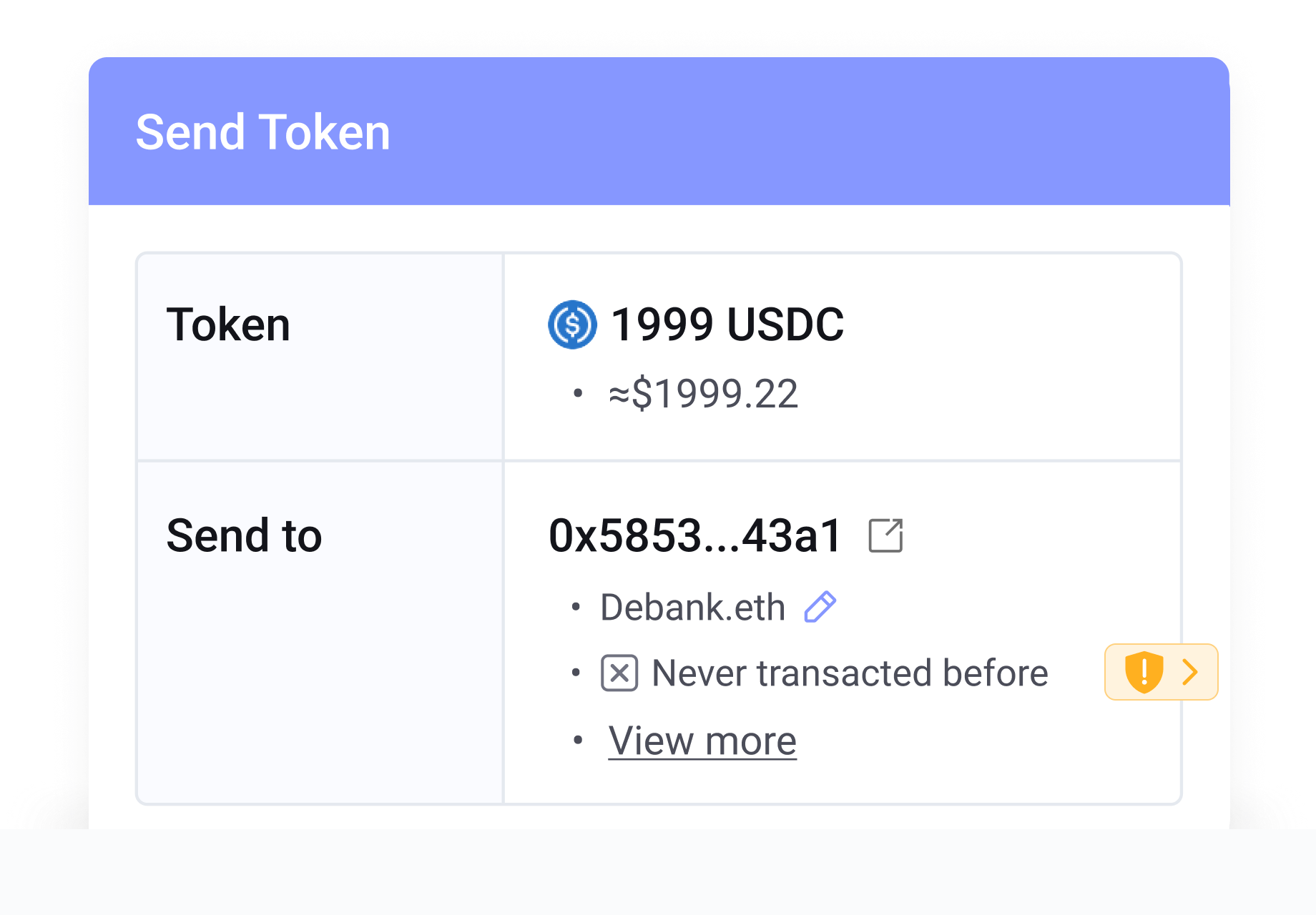
Mechanism first: what Rabby simulates and how that prevents “blind signing”
Rabby runs a dry-run of the transaction against the target network state before asking you to sign. Practically that means the wallet constructs the exact transaction payload the dApp requests, submits it to a local or remote simulation engine, and returns a human-readable outcome: estimated token balance changes, fees, and red flags (for example, previously exploited contracts or suspicious approval patterns). The result is not a private-key cryptographic guarantee—it’s a stateful prediction based on the current chain state—but it turns an opaque hex blob into numbers and warnings you can reason about.
Why that matters: most malicious or accidental losses in DeFi happen because users sign transactions whose effects they don’t understand—“blind signing.” A simulation translates the low-level operations into immediate accounting: “You will lose X tokens; contract Y will receive approval for Z amount; estimated gas is Q.” That immediately changes decision quality. Where users once relied on reputational heuristics (trusted domain, UI polish), they can now rely on immediate, transaction-specific evidence.
What the simulation can and cannot do — trade-offs and practical limits
Simulation is powerful, but it’s not omnipotent. Established capabilities include: estimating token balance deltas, showing gas costs, detecting approvals and allowance resets, and flagging known-bad contracts. Rabby augments this with a security engine that alerts for hacked contracts or suspicious recipients. These features scale well across the wallet’s broad multi-chain support—over 90 EVM-compatible networks—and plug into hardware wallets and institutional setups like Gnosis Safe and Fireblocks.
Limitations to keep in mind: simulations reflect the current on-chain state and assume no state change between simulation and finalization. On congested chains or during mempool reorderings, a malicious actor can front-run or sandwich a transaction, changing the real outcome. Likewise, cross-chain actions that depend on off-chain relayers or time-delayed bridging steps are harder to simulate with full fidelity. And simulation cannot compensate for the wallet’s other limitations: Rabby does not provide a built-in fiat on-ramp or native staking inside the wallet, so some workflows still require external services.
How the simulation fits into a secure workflow (a decision-useful heuristic)
For a DeFi power user, the simulation is another input in a layered security posture. Here’s a reproducible heuristic you can apply before signing complex transactions:
1) Run the simulation and confirm net token deltas match the dApp’s expected outcome. If token outflow isn’t explainable (e.g., unexpected transfers to a third address), don’t sign. 2) Check approvals: if the transaction grants broad, unlimited approvals, pause and prefer a limited allowance or use Rabby’s revocation tool afterward. 3) Note gas estimate and slippage: unusually high or low gas relative to similar operations can indicate a buggy contract or an attempted exploit. 4) Combine simulation output with off-chain intelligence—project reputation and recent audits—before proceeding.
This is practical: the wallet gives you a precise accounting of “what will change” and you add context of “what should change.” The gap between those two is the high-risk zone.
Comparative clarity: Rabby versus the alternatives
Many wallets provide UI warnings or rely on heuristics; Rabby’s distinctive choice is to place transaction simulation at the center of the signing flow. Compared to MetaMask or Trust Wallet, Rabby aims to make the transaction atomic to the user’s understanding by rendering exact balance changes and pre-transaction risk signals. That said, no single wallet buys you immunity: MetaMask has wider distribution and more integrations; Coinbase Wallet has simpler onboarding; hardware-wallet-first flows still require simulation-compatible integrations to realize the same safety gains.
For institutional users, Rabby’s integrations with multi-sig and custody solutions are meaningful. A multi-sig that also displays the same simulation results to each signer raises the bar: every approver is looking at the same deterministic “what changes” readout. That reduces social-engineering risk inside teams and creates a reproducible audit trail for approval rationales.
Security history and what it implies about residual risk
One useful reality check: Rabby experienced a smart-contract exploit tied to Rabby Swap in 2022, costing roughly $190,000. The team froze the exploited contract, compensated users, and increased audits. Two lessons follow. First, simulation and audits are complementary: simulations help users catch dangerous transactions at the moment of signing, but secure contract design and operational controls prevent on-chain vulnerabilities in the first place. Second, a past incident is not proof of systemic unreliability—what matters is responsiveness, remediation, and changes implemented afterward. Rabby’s open-source MIT license makes independent audits possible, which improves trust if third parties regularly examine the codebase.
Install paths and practical setup notes for US power users
Rabby is available across major access points: as a Chromium-based browser extension (Chrome, Brave, Edge), mobile apps for iOS and Android, and desktop clients for Windows and macOS. If you rely on hardware wallets, Rabby’s support for Ledger, Trezor, Keystone, and others means you can combine cold-key security with pre-signature simulation. For users migrating from other wallets, Rabby permits seed-phrase or private-key import and includes a Flip toggle to swap default extension behavior with MetaMask—handy during gradual migration.
If you want to inspect the UI and download installers, the official project pages and release notes are the right starting point; many advanced users pair local desktop installs with hardware wallets and leave browser extensions disabled except when needed. For convenience, a browser extension link that explains installation and features is available as a practical reference: rabby wallet extension.
Where simulations will struggle next — and what to watch
Simulation accuracy will be tested as DeFi flows grow more cross-chain and rely on off-chain components. Two pressure points to monitor: first, cross-chain bridges and relayers where simulation cannot fully model final ultimate effects until the bridge finalizes; second, MEV and mempool-level attacks where the on-chain state can change between simulation and mining. Improvements to on-chain or mempool-level signaling (e.g., native transaction bundles or pre-bundled rollups) could reduce these gaps, but for now users must treat simulation as a necessary but imperfect lens.
Practically, watch for: (1) wallet updates that integrate bundle submission or relay-level protections, (2) broader adoption of atomic swaps that minimize intermediate approvals, and (3) increased standardization of human-readable simulation outputs across wallets. Any of these would materially reduce the residual risk that simulation alone can’t catch.
FAQ
Does Rabby’s simulation make signing risk-free?
No. Simulation significantly reduces the “blind signing” risk by showing expected token changes and fees, but it can’t prevent time-of-execution attacks (front-running, sandwiching) or fully model off-chain processes like some bridge finalizations. Treat simulation as a high-quality signal, not a guarantee.
Can I use Rabby with my Ledger or Trezor?
Yes. Rabby supports major hardware wallets (Ledger, Trezor, Keystone, and others). Combining a hardware wallet for key custody with Rabby’s simulation and approval-revocation tools is a strong security posture for power users.
Will Rabby buy crypto with my credit card inside the wallet?
Not currently. Rabby lacks a native fiat on-ramp, so purchasing crypto directly with fiat requires an external exchange or service. That’s a deliberate product boundary and an operational trade-off: Rabby focuses on transaction safety and multi-chain interactions rather than custody-adjacent fiat flows.
How should teams and institutions use Rabby differently than individual traders?
Institutions should pair Rabby with multi-sig or enterprise custody providers (Gnosis Safe, Fireblocks, Amber, Cobo) and establish a policy where every signer verifies the simulation output before approving. This converts the simulation into an auditable step in approval workflows.
Decision takeaway: treat Rabby’s transaction simulation as a structural upgrade to your DeFi mental model. Instead of guessing what a hex blob does, you should demand a concrete accounting of balance changes and approvals before you sign. That shifts power back to the user—but not entirely to automation: the final step still requires judgment. Use simulation to reduce cognitive load, not to outsource responsibility. When paired with hardware keys, approval revocation, and institutional multi-sig, simulation becomes one part of a layered armor that is especially useful for multi-chain, high-risk DeFi activity in the US market.